What Are the Types of CNC Machines by Axis Count?
Machine tools used in industrial precision machining and by defense industry CNC companies are classified by their number of axes according to the geometric complexity of the workpiece. Selecting the appropriate axis configuration allows a part to be completed in a single setup—minimizing datum transfer errors and reducing unit production cost:
- 2-Axis and C/Y-Axis CNC Turning Centers: Basic CNC lathes operate across 2 linear axes: X (diameter) and Z (length). Modern C-axis and Y-axis live-tooling turning centers angularly index the main spindle and drive rotating milling tools, completing face/OD milling, keyway slotting, and off-center drilling in a single setup without unclamping the part.
- 3-Axis CNC Machining Centers (X, Y, Z): The most common vertical or horizontal milling configuration where the cutting tool moves along three linear axes—ideal for prismatic blocks, mold plates, and enclosures.
- 4-Axis CNC Milling (X, Y, Z + A/B Rotary Indexer): A rotary table added to the linear axes enables four-sided tombstone machining or continuous helical slot milling around cylindrical bodies in one setup.
- 5-Axis Simultaneous CNC Machining Centers: Simultaneous movement across five axes machines complex turbine blades, aerospace structural bulkheads, and compound-angle undercuts with micron accuracy in a single clamping.
Engineering Note: For predominantly cylindrical defense components featuring wrench flats, flange bolt circles, or radial pockets, utilizing a C/Y-axis sub-spindle CNC turning center eliminates secondary milling fixtures—reducing concentricity runout to zero and lowering lead times.
Specialized CNC Technologies by Machining & Cutting Process
- Swiss-Type Sliding Headstock CNC Lathes: Specialized turning machines with guide bushings designed for high-volume, zero-deflection micron machining of slender, small-diameter shafts such as military connector pins and medical implants.
- CNC Wire EDM & Sinker EDM: Non-contact thermal spark erosion systems that cut hardened tool steels and exotic superalloys to ±0.002 mm accuracy without inducing mechanical cutting stresses.
- CNC Laser, Plasma, Waterjet & Router Systems: Used for sheet and plate profiling. In particular, CNC Abrasive Waterjet cutting slices armor steel, titanium, and composites via cold supersonic erosion without creating a Heat-Affected Zone (HAZ).
CNC Machining Envelopes, Table Sizes, and Tolerance Limits
Standardized industrial work envelopes, raw stock allowances, and achievable tolerances by machine category are summarized below:
| CNC Machine Category | Typical Work Envelope / Table Size | Standard vs. Precision Tolerance |
|---|---|---|
| C/Y-Axis CNC Turning & Milling Centers | Ø300–Ø400 mm turning diameter / 500–1200 mm turning length | Standard: ±0.05 mm | Precision: ±0.005 mm (Micron) |
| CNC Laser & Plasma Cutting (Sheet Metal) | 1500 × 3000 mm (Compact) | 2000 × 6000 mm / 3000 × 6000 mm (Industrial) | ±0.10 mm – ±0.25 mm (1 mm – 25 mm plate thickness) |
| CNC Router (Aluminum, Plastics, Composites) | 600 × 900 mm (Shop) | 1500 × 3000 mm & 2000 × 4000 mm (Sheet) | ±0.10 mm – ±0.20 mm |
| CNC Gantry & Abrasive Waterjet | 2000 × 4000 mm – 3800 × 2500 mm | ±0.05 mm – ±0.15 mm (Cold cutting, zero HAZ) |
When preparing raw stock for precision machining, a +2 mm to +3 mm machining allowance per axis is typically added to the nominal part dimensions to remove mill scale and establish true datum surfaces.
Selecting the Right CNC Machine & Supplier for Your Project
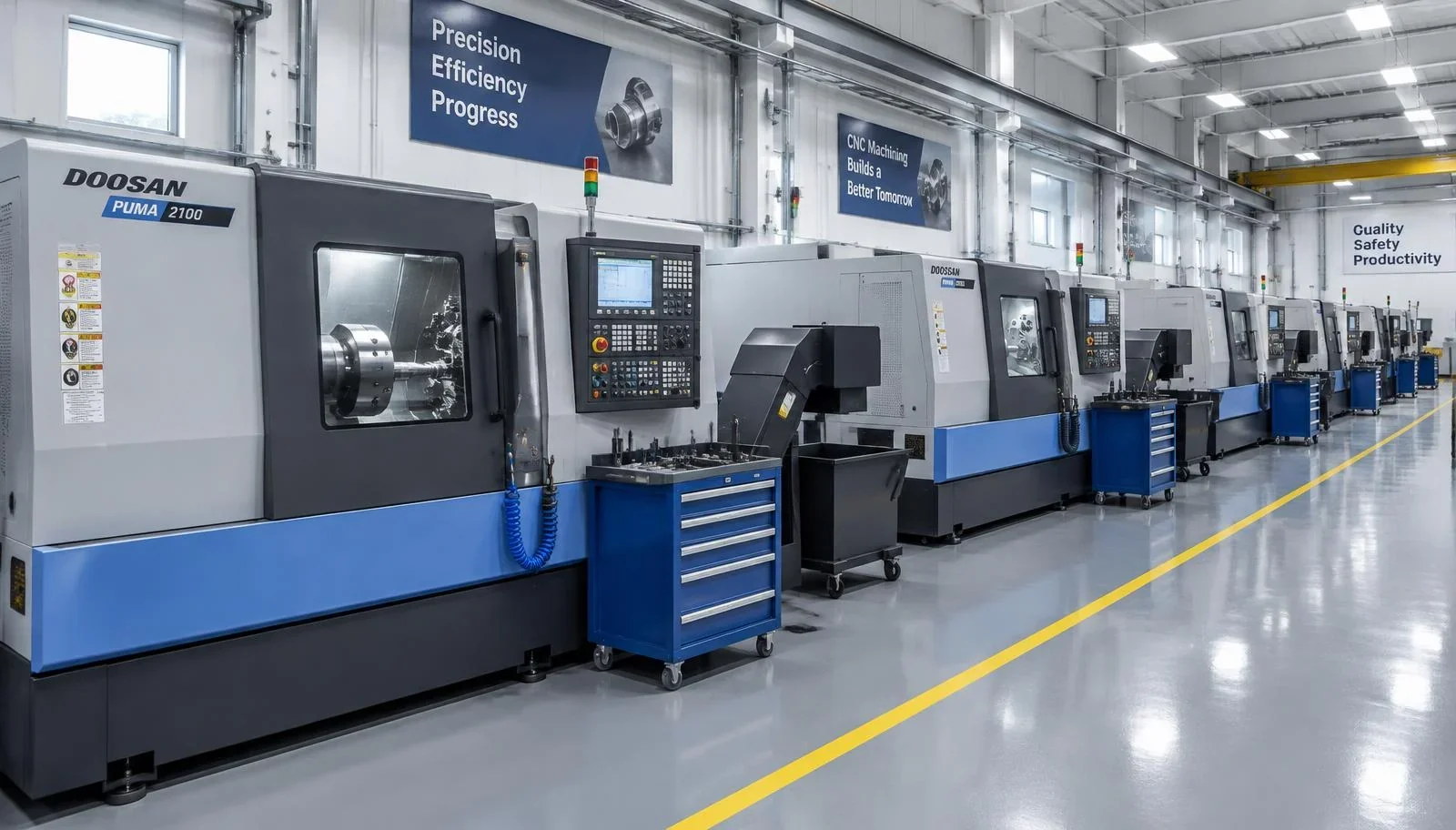
At ASEL Defense in Ankara İvedik OIZ, we manufacture micron-precision components for defense, aerospace, and industrial applications using our DN Solutions PUMA 2600SY II (Y/C-axis with sub-spindle) and Lynx 2100LSYB multi-axis turning centers. You can explore our Machine Fleet, browse more articles in our Technical Guide, or share your technical drawings via our Contact page for a quotation.
Frequently Asked Questions (FAQ)
What is the difference between a C/Y-axis CNC lathe and a standard 2-axis CNC lathe?
While a standard 2-axis lathe performs only cylindrical turning, C- and Y-axis turning centers feature driven live tools that mill flats, cut keyways, and drill off-center holes in a single setup without transferring the part to a separate milling machine.
What are the standard and micron tolerance limits in precision CNC machining?
In general commercial machining, ±0.1 mm (ISO 2768-m) is standard, whereas defense and aerospace precision CNC machining routinely operates within ±0.01 mm to ±0.002 mm (2–10 microns).